Bella Baxter · Victoria McCandless
Poor ThingsBella Baxter / Victoria McCandless is the novel’s divided-life protagonist: the same woman is reckoned as born in a Manchester slum in 1854 and, by the birth of her brain, in Glasgow in 1880. The later name Victoria becomes the basis of her medical career and public work, but her own account traces that life back through domestic servitude, an unhappy marriage, and the intervention of Godwin Baxter. Her story turns on the difference between an identity imposed by others and a life she gradually acquires the means to direct.
Identity and Two Origins
Victoria’s history resists a single, uncomplicated chronology. In the novel’s final reckoning, her body was born in Manchester in 1854, while her brain was born in the Humane Society mortuary on Glasgow Green on 18 February 1880. The account gives both beginnings their force: the former makes her ninety-two at death, while the latter makes her exactly sixty-six years, forty weeks, and four days old. Her later life was lived under the name Victoria, although Bella Baxter is the identity attached to the account of her earlier history. These names mark not merely a change of label but a life narrated through distinct origins.
Victoria describes the education that preceded her escape as training for different forms of dependence. Her mother had prepared her to serve a working man at home; the convent school in Lausanne prepared her to be a wealthy man’s ornament. She learned French, dancing, piano, and the manners of a lady, along with a narrow account of current affairs filtered through Conservative newspapers. The nuns, as she understands it, offered this knowledge because prospective husbands might prefer wives with some familiarity with the world. Her skills expanded, but the purpose assigned to them remained marriage.
Marriage and Godwin Baxter’s Intervention
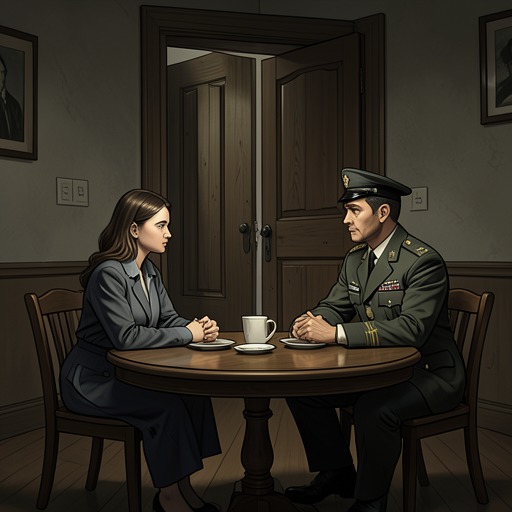
After her mother’s death, Victoria married General Sir Aubrey de la Pole Blessington. She recalls being happy on the wedding day: he was rich, famous, handsome, and an accomplished waltzer, and marriage offered an escape from her father. The couple’s public appearance drew the attention of other dancers, but Victoria’s attraction and relief did not protect her from what followed. On the wedding night she discovered the reason her husband had acquired two unflattering nicknames among his fellow officers, yet initially concluded that the fault lay with her.
Six months later, after her third hysterical pregnancy, she was begging for a clitoridectomy. Dr. Prickett told her that a Scottish surgeon in London might perform the operation and arranged for Godwin Baxter to visit. Victoria explained her childhood, education, and marriage; Godwin questioned the reasoning that had made her seek surgery. He opposed the operation and told her that the men who had treated her badly were themselves shaped by a destructive education. His intervention did not erase what had happened, but it interrupted the expectation that Victoria should submit to a procedure sought for her husband’s purposes.
Godwin also offered a practical refuge, but sheltering a runaway wife of an English baronet and general made an honest explanation dangerous. To deflect questions, he invented South American married cousins who had died in a train crash and an amnesiac daughter, Bella Baxter. Under that protective identity, he could teach Victoria what she had not been taught without requiring her to discard what she already knew. His instruction included a warning to preserve painful memories and approach them with intelligent interest. Victoria resisted: the hurt of scrubbing clothes in freezing water, repeating piano exercises, being struck by her father, and memorizing an unappealing book seemed to belong to separate worlds, linked only by pain. The disagreement establishes memory as an active part of her self-formation rather than a past she can simply leave behind.
Medical Work and Teaching
In 1886 Victoria used her later name to enrol at the Sophia Jex-Blake School of Medicine for Women in Edinburgh. Glasgow University awarded her the degree of Doctor of Medicine in 1890. That same year she opened the Godwin Baxter Natal Clinic in Dobbie’s Loan, near the Cowcaddens. The clinic was entirely charitable, and she ran it with a small staff of local women whom she trained herself.
Victoria treated teaching as part of the clinic’s work, not as a reason to keep capable assistants permanently dependent on her. She did not retain an employee for more than a year after training her. When a devoted helper wanted to stay, Victoria explained that there was nothing more she could teach her and urged her to serve her neighbours or learn from another doctor. Some assistants went on to enrol as nurses in city hospitals. Their questioning habits did not always please their superiors: one ward sister complained that they asked too many questions. In this small consequence of Victoria’s training, inquiry becomes both a professional inheritance and a source of friction with established authority.
Between 1892 and 1898, Victoria gave birth to three sons at two-year intervals. She continued clinical work until the final two or three days of each pregnancy and returned soon afterwards. She connected this practice to the circumstances of her patients, poor women who could not afford to stop working and become, in her pointed term, horizontalists. She also acknowledged that her own circumstances were more fortunate because her husband was a very good wife to her. The contrast makes her working life neither a claim that every woman has equal freedom nor a simple rejection of domestic responsibility: she recognizes the material pressures her patients face and the support that enables her to keep practising.
Public Thought and Historical Legacy
A letter dated 1 August 1914 shows Victoria extending her concern from individual patients to the organization of public life. She celebrates Glasgow’s municipal development, educated skilled labour, expanding Co-operative movement, and telephone system, while warning that the confidence surrounding industrial progress has a dangerous source: government contracts for warships built along the Clyde, produced in response to German naval construction. Her optimism is therefore qualified by an account of the economy’s entanglement with militarization.
Victoria also places hope in international working-class action. She notes that labour and trade-union leaders in Germany and Britain had agreed to call a general strike if their governments declared war. She even imagines that such a response might transfer practical and moral control from owners to the people who make what society needs. Addressing a child of the future, she wishes for a saner and happier world. This political confidence grows from the same attention to material conditions visible in her clinical practice: health, work, education, and power cannot be separated.
Victoria’s medical vocation also intersects with the work of her husband, Archibald McCandless. He wanted her to edit his book and used a section she was qualified to correct as an indirect request for collaboration, but she failed to recognize the invitation. The episode qualifies any picture of their partnership as effortless mutual understanding, even as she describes him as supporting her continued work and family life.
Dr. Victoria McCandless was found dead of a cerebral stroke on 3 December 1946. The two calculations of her age preserve the story’s defining division: ninety-two years from the birth of her body in Manchester, or sixty-six years, forty weeks, and four days from the birth of her brain in Glasgow. Neither measurement cancels the other. Together they frame a character whose later achievements do not make her earlier suffering disappear, and whose account makes remembering that suffering part of the work of becoming a self.